Boussinesq convection
A buoyancy-driven flow constructed by the Method of Manufactured Solutions to measure accuracy when temperature and momentum are two-way coupled.
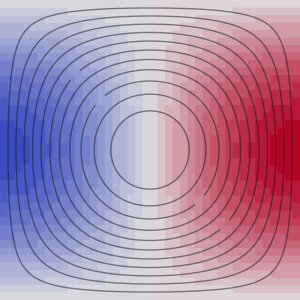
The problem
Buoyancy drives many of the flows that matter in practice (data-center cooling, HVAC, electronics thermal management), where warm fluid rises and the resulting motion redistributes the heat. This case tests that two-way coupling directly: temperature forces the flow through buoyancy, and the flow in turn transports the temperature.
The coupled system has no convenient closed-form solution, so the Method of Manufactured Solutions is used. A smooth temperature and velocity field is chosen in advance, the exact heat source that makes it a solution is derived analytically, and the solver is checked against the known field. The field is built so that buoyancy is load-bearing: it carries the momentum balance, so the coupling cannot be quietly bypassed.
Manufactured solution
What we measured
The mesh is refined from 8 to 48 cells per side and each level is driven to steady state, with the error measured in temperature, velocity and pressure norms.
As a control, the same run is repeated with buoyancy switched off: the velocity error grows by roughly a hundredfold. That confirms the coupling is genuinely being exercised, and the agreement is not an artifact of seeding the solver with the answer.
Results
Refined across four meshes, the temperature error falls at order 2.05 and the velocity at 2.01, both at the theoretical 2.00, with pressure and the gradient norms close behind.
Overall accuracy of the predicted temperature
expected 2.00→2.05
Overall accuracy of the buoyancy-driven flow
expected 2.00→2.01
Overall accuracy of the pressure
expected 1.00→1.91
Accuracy of temperature gradients (heat flux)
expected 1.00→1.01
| Mesh size h | Temperature error | Rate |
|---|---|---|
| 0.1250 | 3.77 × 10⁻² | — |
| 0.0625 | 8.81 × 10⁻³ | 2.10 |
| 0.0313 | 2.15 × 10⁻³ | 2.03 |
| 0.0208 | 9.53 × 10⁻⁴ | 2.01 |
Every field (temperature, velocity, pressure) hits its textbook order, with buoyancy load-bearing throughout.
Temperature converges at order 2.05 and velocity at 2.01, both matching the theoretical 2.00, with buoyancy load-bearing throughout.