Ethier–Steinman flow
A fully three-dimensional, time-dependent Beltrami flow with an exact Navier–Stokes solution, used to measure spatial accuracy in 3D.
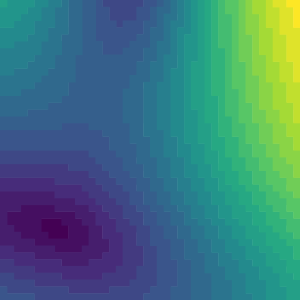
The problem
The Ethier–Steinman flow, introduced by Ethier and Steinman in 1994, is an exact unsteady solution of the three-dimensional Navier–Stokes equations on a cube. It is a Beltrami flow (the velocity is everywhere parallel to its own vorticity), and all three velocity components are nontrivial and mutually coupled, with the entire field decaying smoothly in time.
Because every spatial derivative is genuinely three-dimensional, the case exercises the full 3D discretization rather than an extruded planar pattern. As with Kovasznay, the exact field is imposed on all six faces, so the interior deviation is pure discretization error.
Exact solution (a = π/4, d = π/2, ν = 1/Re)
What we measured
The mesh is refined from 8 to 48 cells per side with the timestep held fixed and small, so the measured error is spatial rather than temporal. Each level is seeded with the exact initial field and advanced a short time before the error is taken.
The velocity error falls at order 1.97, matching the theoretical 2.00 for this discretization, with pressure and velocity gradients converging at their own expected rates.
Results
Refined across six meshes in full 3D, the velocity error falls at order 1.97, essentially the theoretical 2.00, and the rate holds steady at every refinement rather than drifting. Velocity gradients and pressure converge at their own expected rates alongside it.
Overall accuracy of the 3D flow field
expected 2.00→1.97
Accuracy of velocity gradients
expected 1.00→1.06
Overall accuracy of the pressure
expected 1.00→1.94
| Mesh size h | Velocity error | Rate |
|---|---|---|
| 0.2500 | 3.85 × 10⁻² | — |
| 0.1250 | 9.59 × 10⁻³ | 2.01 |
| 0.0833 | 4.30 × 10⁻³ | 1.98 |
| 0.0625 | 2.45 × 10⁻³ | 1.95 |
| 0.0500 | 1.60 × 10⁻³ | 1.93 |
| 0.0417 | 1.12 × 10⁻³ | 1.94 |
The rate stays near two at every level, and refining the timestep further does not lower the error, so the slope is genuine spatial accuracy.
Velocity converges at order 1.97 against the theoretical 2.00, with a steady rate at every refinement, confirming second-order spatial accuracy carries into three dimensions.