Kovasznay flow
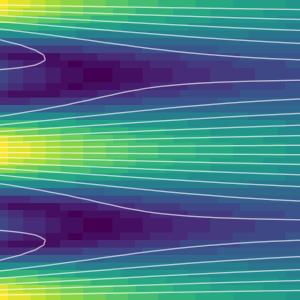
A steady laminar wake behind a two-dimensional grid, one of the few flows with a closed-form solution to the full Navier–Stokes equations.
The problem
Kovasznay flow is the analytic solution derived by L. I. G. Kovasznay in 1948 for the steady, periodic wake downstream of a row of evenly spaced bars. It is periodic across the stream and decays exponentially in the flow direction, and, unusually, it satisfies the full nonlinear Navier–Stokes equations in closed form rather than as an approximation.
That exact form is what makes it a verification workhorse. Every boundary is set to the analytic velocity, the solver is driven to steady state, and the interior solution is compared against the formula point by point. Whatever remains is the solver’s own spatial discretization error, with no turbulence model, no transient, and no experimental uncertainty in the way.
Exact solution (Re = 40)
What we measured
The flow is solved on a sequence of progressively finer meshes, from 8 to 128 cells per side, with everything else held fixed. At each level the steady-state error against the exact solution is measured in three norms: overall velocity, velocity gradients, and pressure.
The quantity of interest is the rate at which that error falls as the cells shrink: the order of accuracy. For a correct second-order scheme, halving the cell size reduces the velocity error by roughly a factor of four, which appears as a slope of two when error is plotted against cell size on log axes.
Results
Refined across five meshes, the velocity error falls at order 1.97, within a few percent of the theoretical 2.00, while velocity gradients and pressure track their own expected rates.
Overall accuracy of the predicted flow field
expected 2.00→1.97
Accuracy of velocity gradients (shear, stresses)
expected 1.00→1.02
Overall accuracy of the predicted pressure
expected 1.00→1.83
| Mesh size h | Velocity error | Rate |
|---|---|---|
| 0.1250 | 4.05 × 10⁻² | — |
| 0.0625 | 1.10 × 10⁻² | 1.88 |
| 0.0313 | 2.80 × 10⁻³ | 1.98 |
| 0.0156 | 7.00 × 10⁻⁴ | 2.00 |
| 0.0078 | 1.75 × 10⁻⁴ | 2.00 |
Each halving of the mesh cuts the error roughly 4×, the signature of a second-order method.
Velocity converges at order 1.97 against the theoretical 2.00, and pressure and velocity gradients clear their expected rates as well.