Reynolds.
The simulation runs itself.
An agentic harness that sets up, runs, monitors convergence of, and interprets real physics solvers. It is not a surrogate model and not a chatbot bolted onto someone else's results. The numbers come from an actual numerical solution, and you can inspect exactly how it got there.
In production on OpenFOAM for CFD, OPM Flow for reservoir simulation, and building design.
01Live sandbox
A real 2D solver, running right here.
This is not a video. A small incompressible fluid solver recomputes the field every frame. Draw obstacles into the wind tunnel, or stamp a cylinder, square, or triangle, and watch the streaklines bend around whatever you build.
This sandbox runs a Lattice Boltzmann solver on a D2Q9 lattice with two relaxation times—useful here, but not our production CFD stack.
grid 192×96 · D2Q9 lattice Boltzmann, two relaxation times · red/blue: counter-rotating vorticity · drag inside the tunnel to add or remove geometry
What this kind of engine answers
Internal and external flow
Pressure drop, flow distribution, recirculation, and wakes for ducts, manifolds, enclosures, and bodies in free stream.
Conjugate heat transfer
Solid and fluid domains solved together: conduction in parts, convection at surfaces, and the temperatures that result.
Incompressible and compressible
Low speed air and water through transonic regimes, with the turbulence model chosen to match the physics rather than the default.
Multiphase interfaces
Free surface and phase interaction cases where stratification and sloshing drive the answer.
02Industrial use cases
One engine. Two industrial use cases.
Each domain is a backend plus a working pattern, not a rebuild. The harness, the agent loop, and the convergence logic stay the same.
03The distinction
What Reynolds is actually doing.
A lot of software gets called AI simulation. Here is where the line sits, because the difference shows up the first time you check a number.
Surrogates learn to imitate solver output and interpolate inside their training data. Reynolds runs the actual solve, so results hold up outside whatever distribution a model was trained on.
The agent operates the solver directly. It writes the case, chooses the settings, launches the run, watches the residuals, and relaunches when something misbehaves. Nothing sits between you and the numerics.
Called once, Reynolds is analysis. Pointed at live telemetry every fifteen minutes, the same engine is Control, our continuous operations product.
04The gap it closes
Your tools can discuss results.
They cannot start the work.
Running a physics simulation is mostly not physics. Someone translates the question into a case, builds or cleans the geometry, meshes it, picks turbulence models and boundary conditions, chooses a discretization scheme that will not blow up, launches the run, watches the residuals, notices divergence, figures out why, adjusts, reruns. Then, separately, they interpret the output into an engineering answer.
That work is repetitive, and the judgment behind it lives in a few people's heads. On a typical ten person team, two people can drive the tool. Everyone else waits. So the daily operational questions never get simulated at all.
Reynolds does all four steps. You supervise and ask questions instead of assembling cases by hand.
05How it works
From question to answer,
without the grunt work.
Case setup
Start from a described problem or a CAD or geometry file. Reynolds produces a valid solver case: geometry cleanup, mesh, boundary conditions, and solver settings.
Execution
Reynolds drives the real solver. The numbers that come back are a numerical solution, not an inference.
Convergence management
Residuals are monitored throughout the run. When a case misbehaves or diverges, Reynolds adjusts and relaunches instead of handing you a broken result.
Interrogation
Ask questions about the result in natural language. Ask a follow-up that requires a different run, and Reynolds goes back and runs it. No human rebuilding the case in between.
06Interfaces
Two ways in.
A web UI for browsing cases, fields, and history. And a terminal where you prompt for an analysis and watch it execute live, closer to how a simulation engineer already works.
Pick a domain on the terminal to see how the same conversation changes shape.
07Solvers
Solver agnostic by design.
The harness, the agent loop, and the convergence logic are separate from any one solver. Adding a domain is a matter of adding a backend, not rebuilding the product.
| Solver | Domain | Status |
|---|---|---|
| OpenFOAM | CFD, conjugate heat transfer, incompressible and compressible flow | Production |
| OPM Flow | Reservoir simulation, multiphase flow through porous media | Production |
| JutulDarcy | Reservoir simulation, secondary option under evaluation | Evaluating |
| More backends to come | ||
Under the hood
Why open source solvers
An agent needs to read and write the full case configuration, and closed commercial solvers do not expose that surface. Open source does.
Nothing hidden
You can inspect exactly what was run: every setting, every iteration. There is no vendor API between you and the numerics, so there is no question about whether the AI made it up.
Next on OpenFOAM: electronics and liquid cooling.
- Chiplet and package thermal, junction temperature under real workload profiles
- Cold plate and liquid cooling loop performance, direct-to-chip and immersion
- Heat exchanger and condenser sizing, conjugate heat transfer between solid and fluid domains
08Verification
What a real solution looks like.
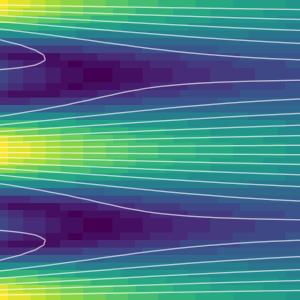
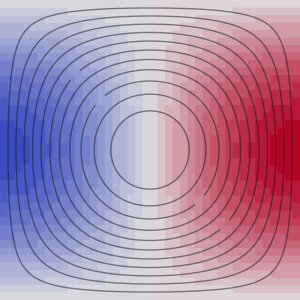
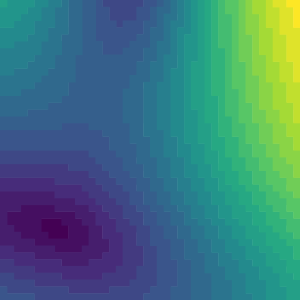
These are canonical verification problems whose exact solutions are known analytically. Our solvers have to reproduce them before anything else ships, and your runs are held to the same standard. Every result comes back attached to the full case setup that produced it.
09Benchmarks
Measured on FoamBench,
against everything else that tries.
End-to-end success rate across the FoamBench suite: a prompt in, a valid converged OpenFOAM case out. Reynolds was evaluated by Inviscid AI on the same suite; competing systems are reported in the third-party evaluations linked above.
See Reynolds run your case.
Bring a problem description or a CAD file. We will set it up and run it live.